Project Sprinkles
| Outcome | VP of Traveller Products buy-in, unlocking cross-vertical collaboration across Experiences, Hotels, and Restaurants |
| My role | Lead Researcher |
| Team | Community, Tripadvisor |
| Methods | Moderated concept-grounded interviews |
| Participants | 12 Passionate Travellers, US and UK |
| Timeline | Aug to Sep 2025 |
The situation
Tripadvisor had a milestone objective to make the platform feel more powered by its community. The reasoning was straightforward: if travellers know that Tripadvisor is built on real perspectives from people like them, they are more likely to trust the guidance and make a confident decision. Trust drives return visits, which in turn drive engagement.
Past research had already established that community content is valuable. Travellers rely on reviews, photos, tips, and forum posts to figure out what to expect and whether something is worth their time. However, Tripadvisor was not surfacing this content well. Pages were long and dense. Travellers struggled with information overload. The community content that could help them make better decisions was often buried or disconnected from where it would matter most.
The Community team hypothesised that sprinkling community-sourced insights throughout key pages could close this gap. The team called these "sprinkles": quick insights shared by or about other travellers, extracted from community content and woven into existing sections on Destination and Detail pages. The idea was to surface them where they are most useful, rather than leaving everything in the reviews section, where most travellers skim rather than read deeply.
The research challenge
What does it mean for a travel platform that is not a social network to feel community-powered, and do travellers value it enough to justify a cross-vertical initiative?
This was not a research question you could answer with a standard concept test or a straightforward set of interviews. The risk was real. Open-ended conversations about "community" on Tripadvisor would almost certainly drift toward comparisons with Facebook, Reddit, or Instagram. Participants would reach for the most familiar frame, and the conversation would end up in a territory that had nothing to do with what Tripadvisor was actually trying to build. Alternatively, the discussion could stay at a level too abstract to produce anything the team could act on.
My UXR manager and I led the thinking on how to make this question researchable. We landed on a decision that shaped the entire study: we would create tangible design concepts to ground the conversations, giving participants something specific to react to rather than an abstract idea to discuss.
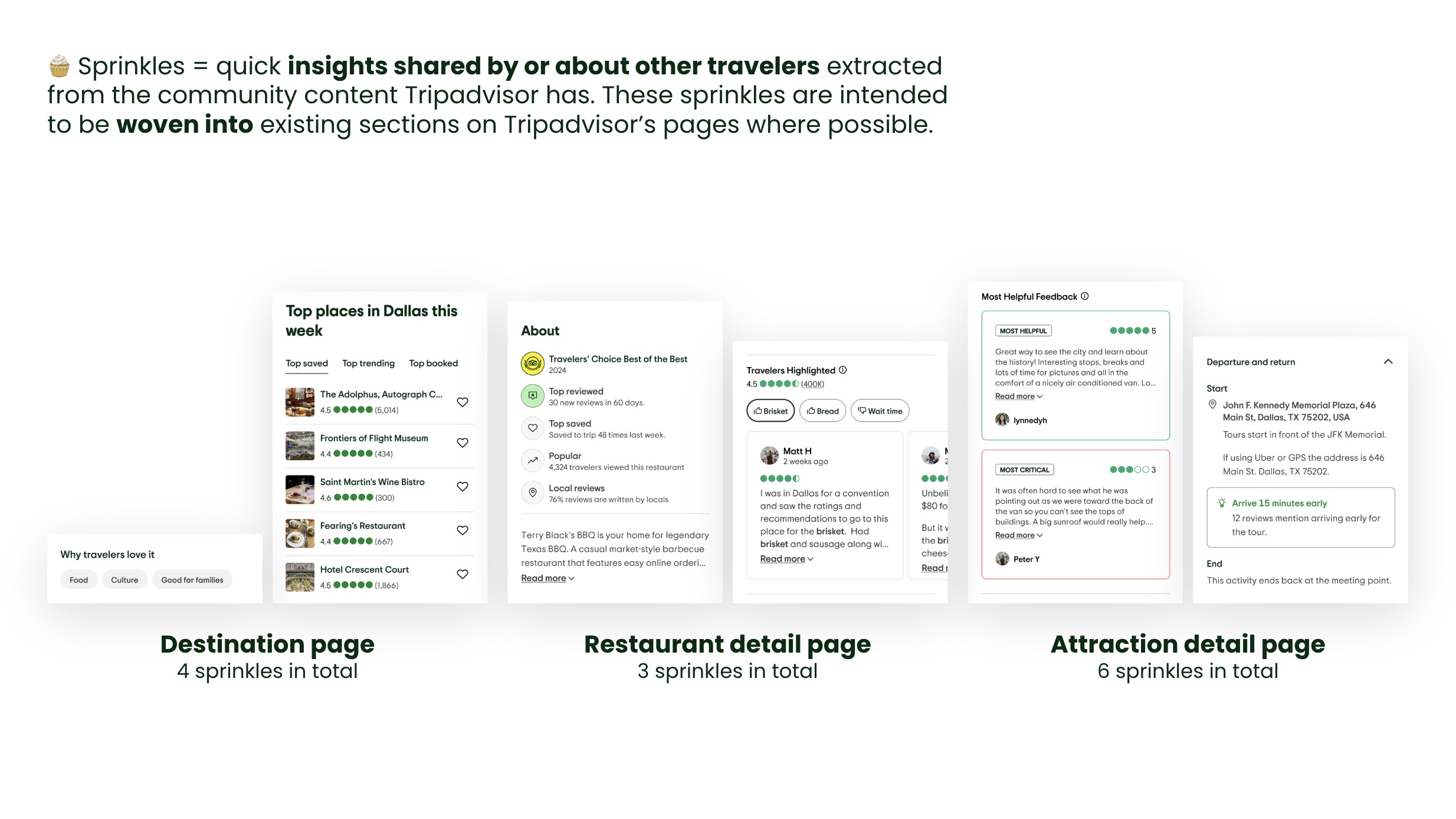
The concepts were not designs under evaluation. They were a research tool, a way to make an abstract strategic question concrete enough to produce clear, useful answers.
What I did and why
I ran 12 live interviews on Dscout with Passionate Travelers from the US and UK. Participants were recruited from Dscout's panel and included a mix of Tripadvisor members and non-members, which was intentional. Feedback from people less familiar with Tripadvisor helped us understand how the sprinkled content landed without the bias of existing platform habits.
In each 60-minute session, participants interacted with design concept prototypes on two page types: a Destination page (Dallas) and Detail pages (a restaurant page and a tour page).
The interview had two parts. The first explored how community content already played a role in participants' travel planning, giving me a baseline before the concepts were introduced.
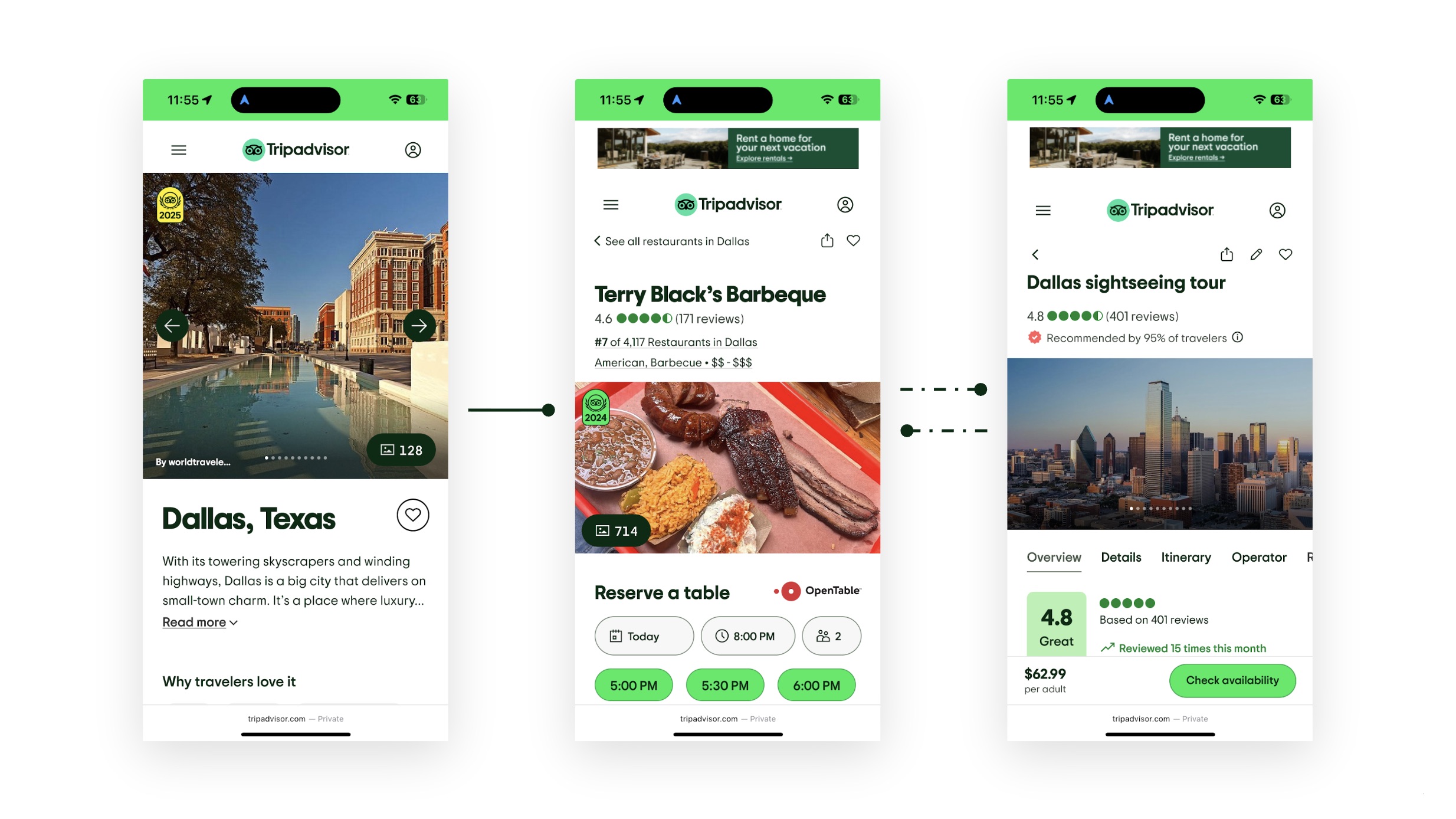
The second placed participants in a planning scenario. They were asked to use Tripadvisor as they would naturally, deciding whether Dallas was the right destination to visit, then whether a specific tour or restaurant was the right choice. The sprinkles were encountered in that context as part of a real decision rather than assessed in isolation.
Participants were not evaluating designs. They were telling me whether the kind of information being surfaced, and the way it was surfaced, actually helped them make decisions. Because they were in decision-making mode rather than critique mode, my probing could focus on what made the sprinkles valuable, where relevance mattered, and why they aided decisions even when the sense of community wasn't always obvious. That focus was what made the findings actionable.
What we found
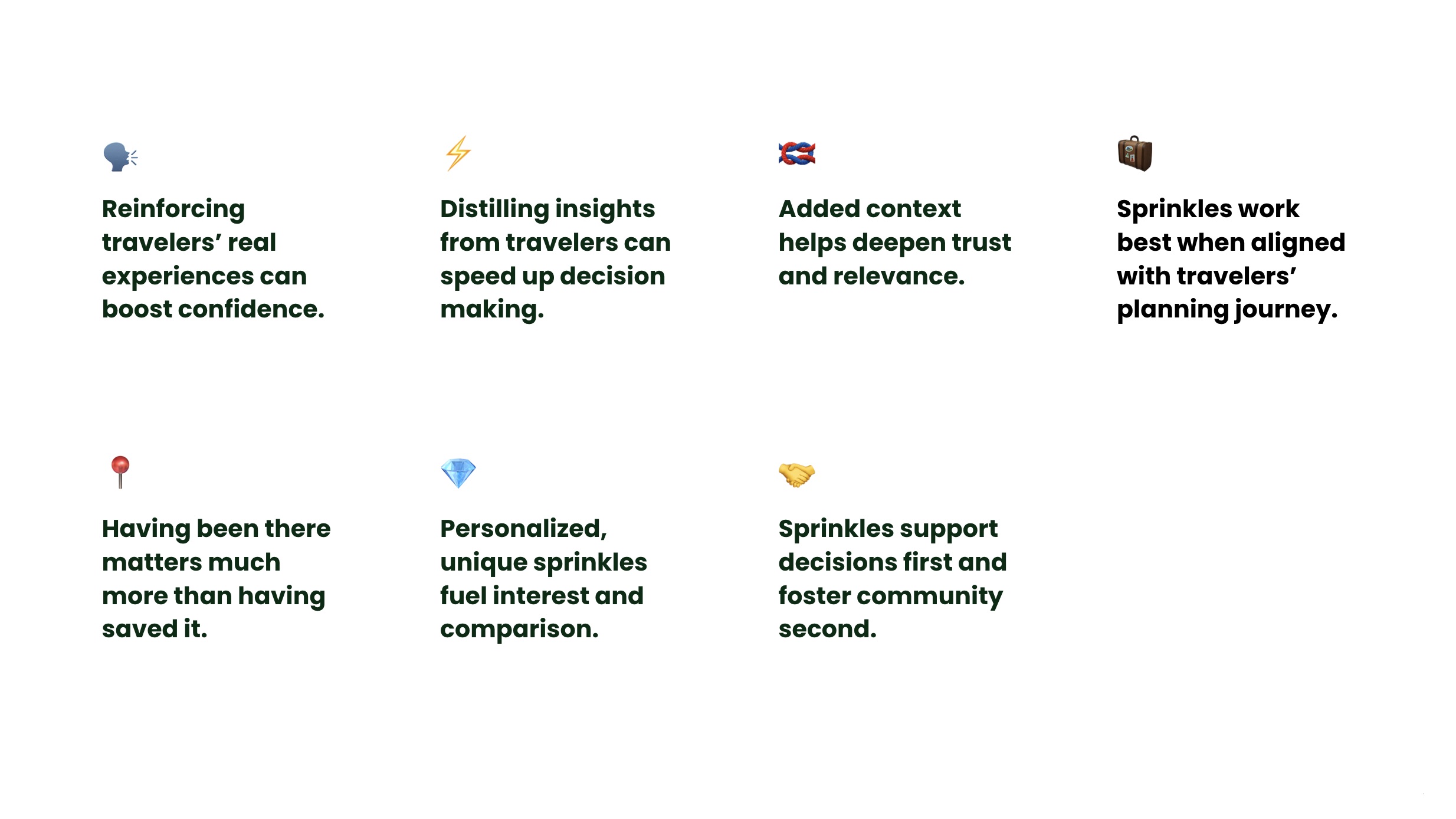
Even though Tripadvisor does not feel like a community the way Facebook or Reddit does, the sprinkles elevated community perspectives in a way that aided and sped up decision-making. Participants did not need Tripadvisor to feel like a social network. They needed it to feel trustworthy and useful. The sprinkles did that.
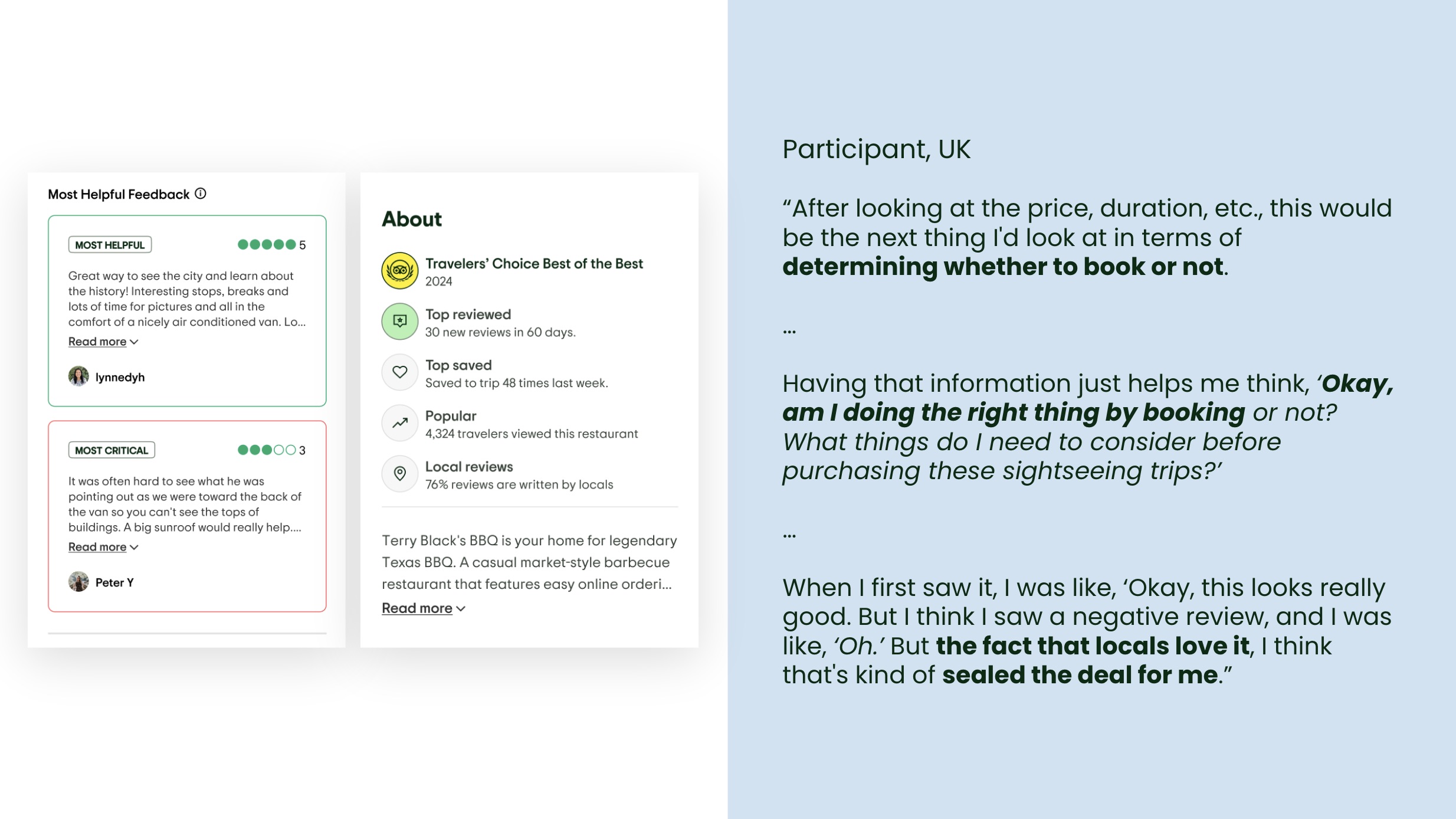
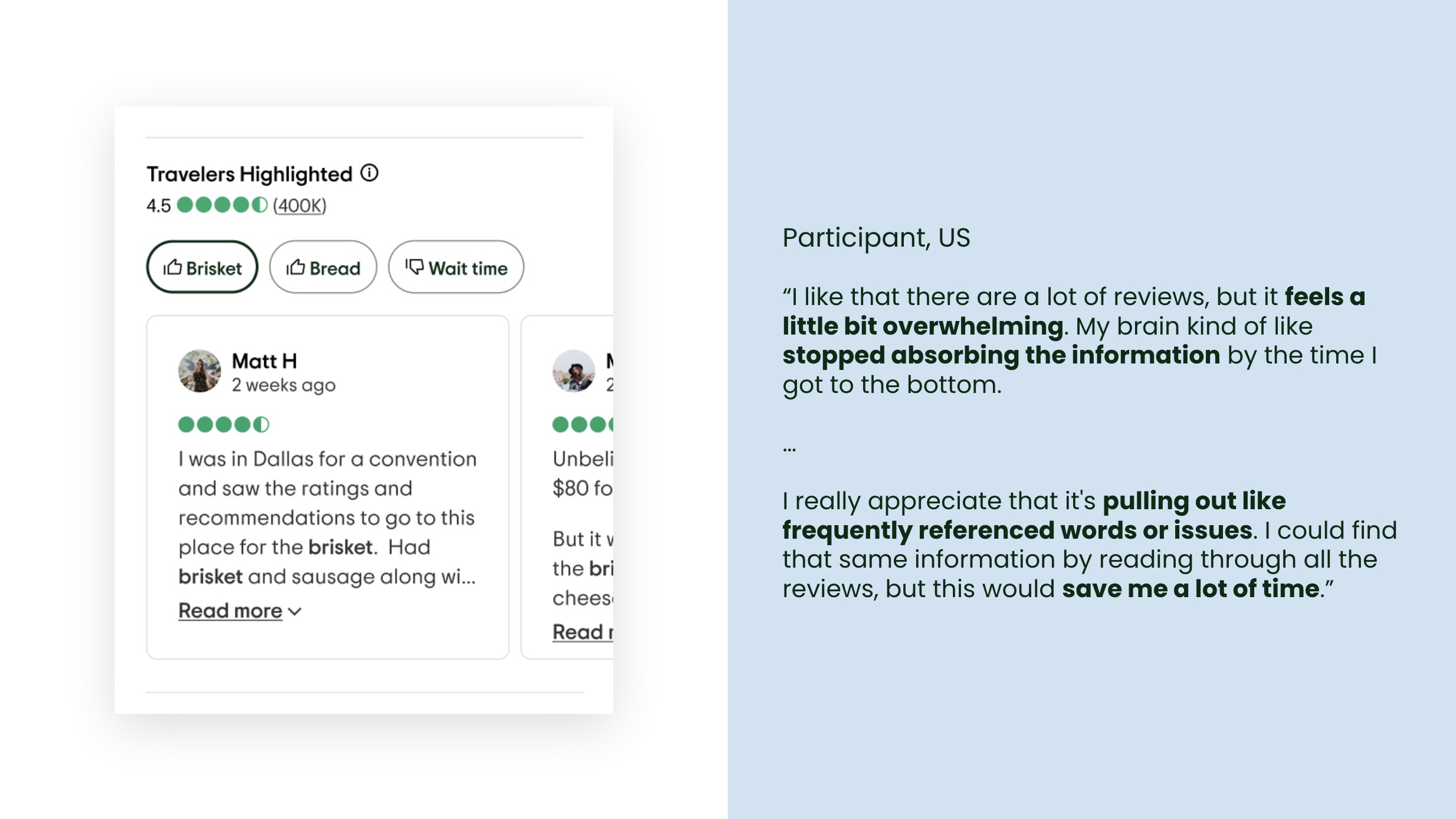
Sprinkles boost booking confidence
Participants recognised and trusted that these perspectives came from real people who had actually been there. That social proof was reassuring. It helped them judge whether a hotel, tour, or restaurant was the right choice, and it did so faster than scrolling through full reviews. Sprinkles distilled a lot of information into a few lines, placed in the top half of the page. Participants appreciated not having to wade through full reviews to get the gist.
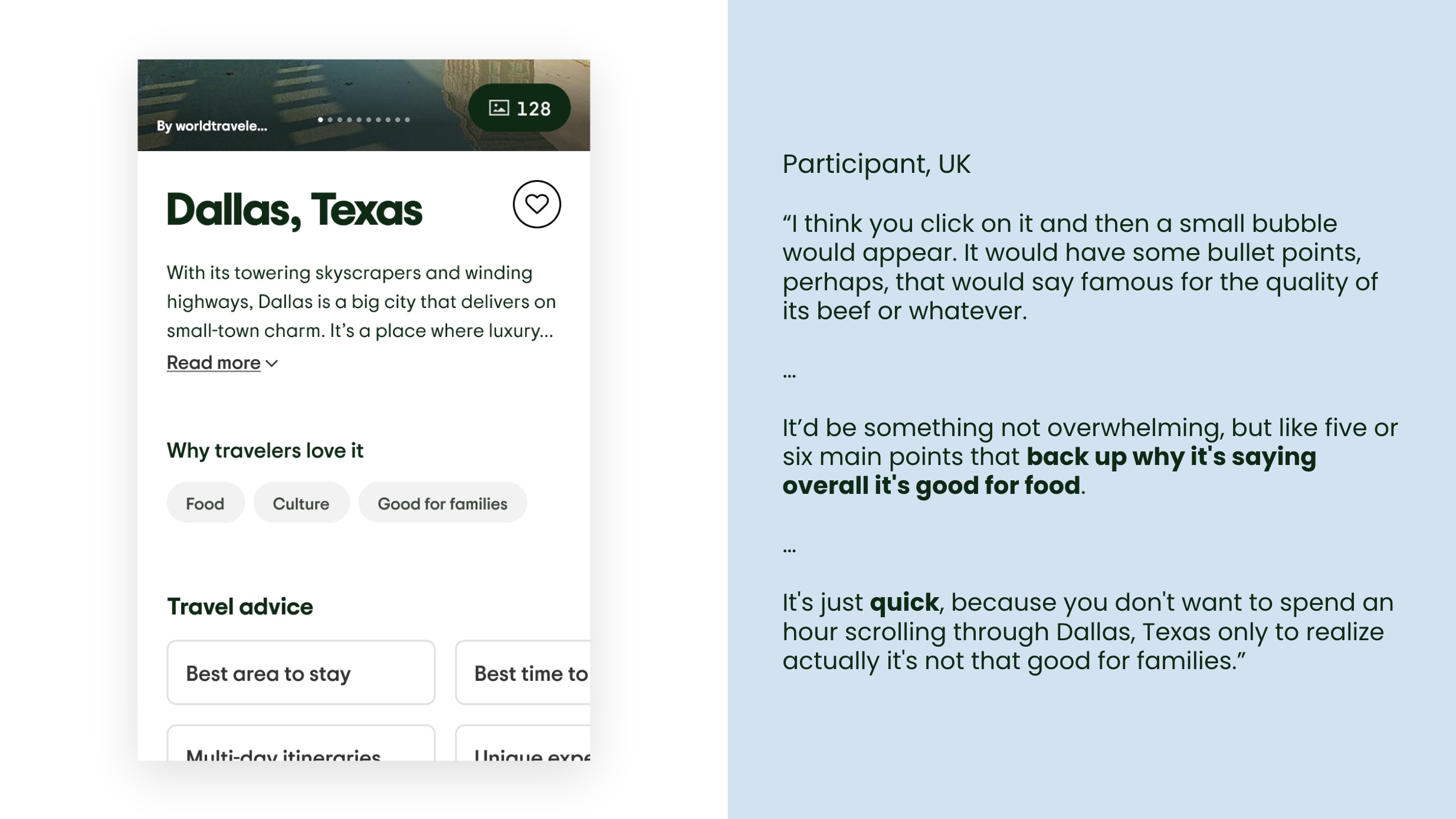
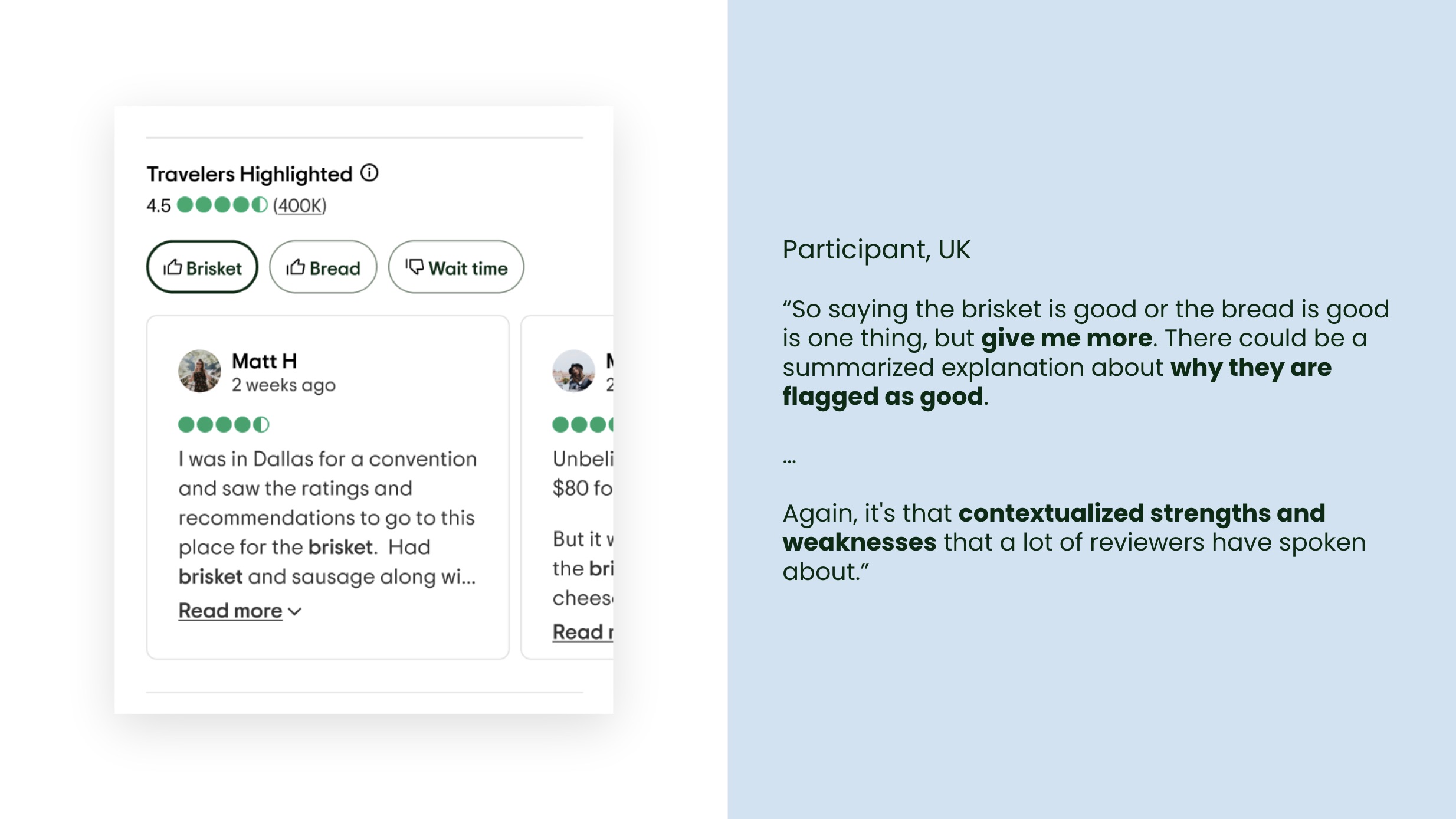
Added context strengthens relevance
Context and relevance mattered more than volume. Participants wanted to know not just what other travellers highlighted, but why. A sprinkle that said a tour was "good for kids" was only useful to someone travelling with children. Content that highlighted what made a place unique or stand out helped participants compare options and move toward a decision. Generic highlights were easy to ignore.
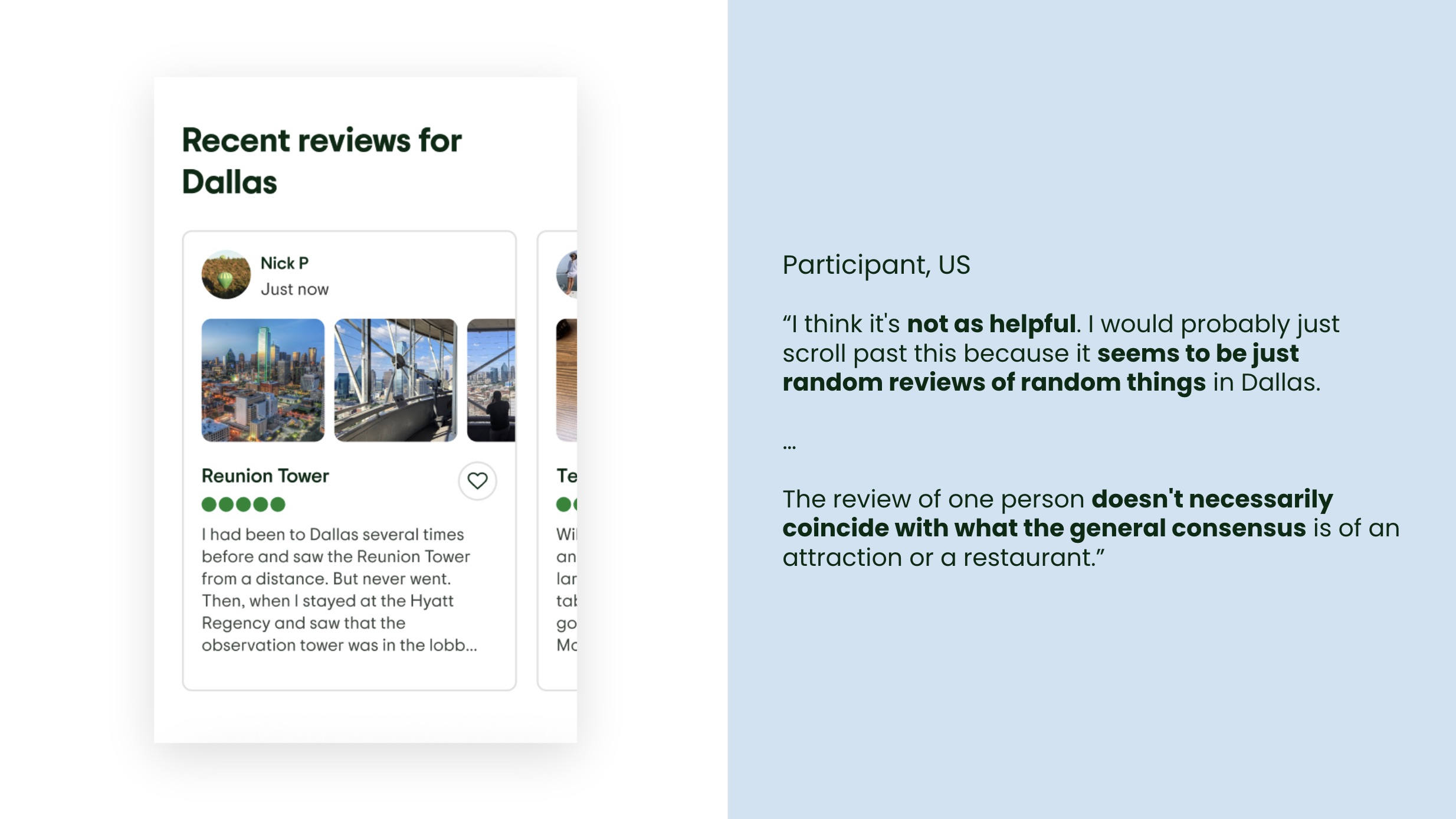
Sprinkles must match travellers' planning process
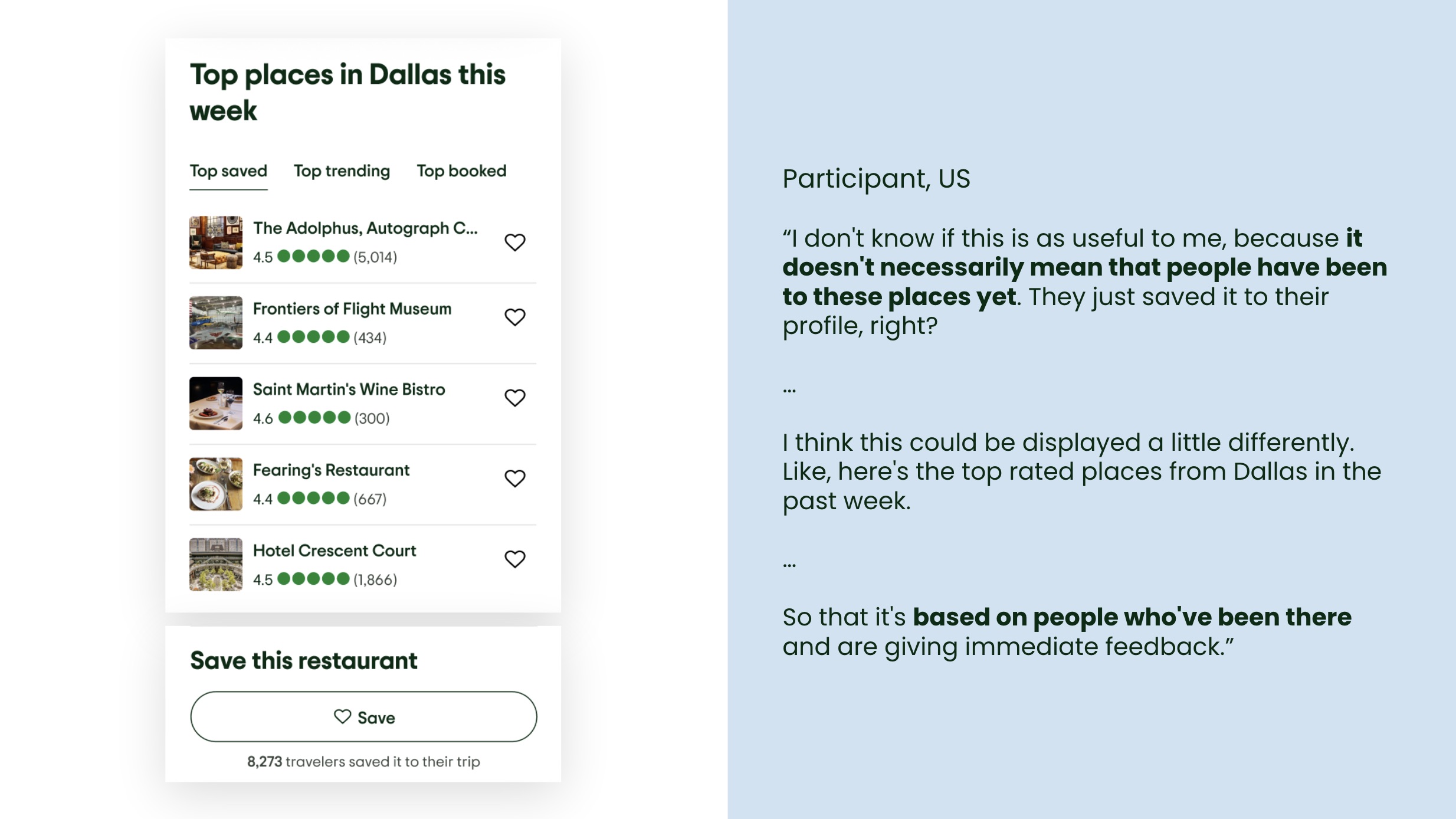
There were clear limits. Sprinkles that did not match where travellers were in their planning journey felt out of place. On the Destination page, isolated reviews of specific places felt unhelpful at the early planning stage. Listings of "top saved" or "top trending" places were less compelling because saving something does not mean you have been there. Participants valued knowing what travellers had to say about their experience, and content based on saves alone did not deliver that.
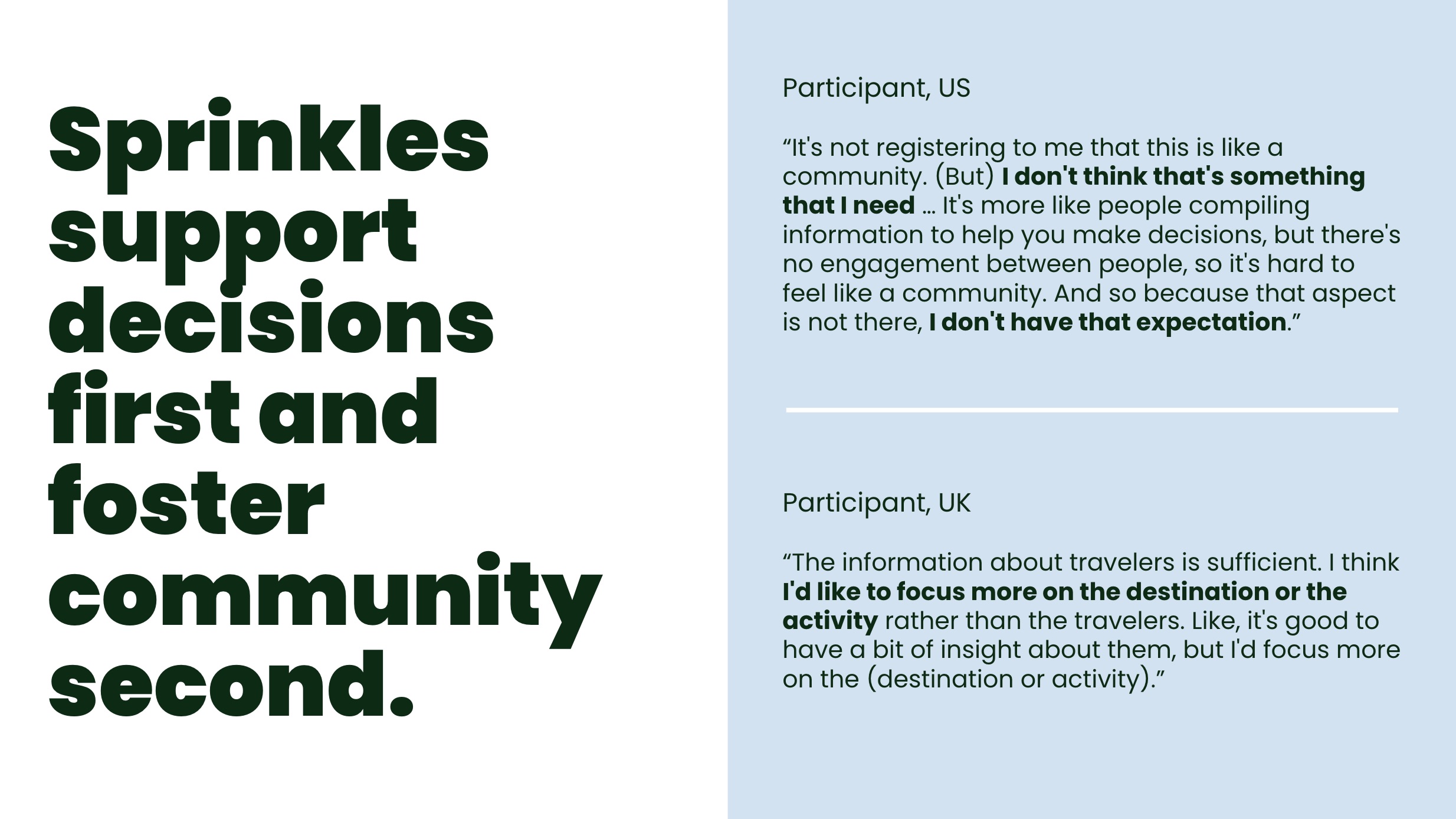
Two participants noted a limited sense of community on the pages, but said this would not stop them from using the sprinkled content to make decisions. This was only mentioned by two people, but it pointed to something worth noting: the sprinkles' primary value was aiding decision-making, not building a feeling of community. Any sense of community was a bonus, not the draw.
What changed
The research gave the team shared language. "Sprinkles" started as a project codename. After the study, it became the word the team and stakeholders used to talk about a specific concept that tested well. That shared vocabulary made it easier to align on what the team was building and why.
It also produced design principles.
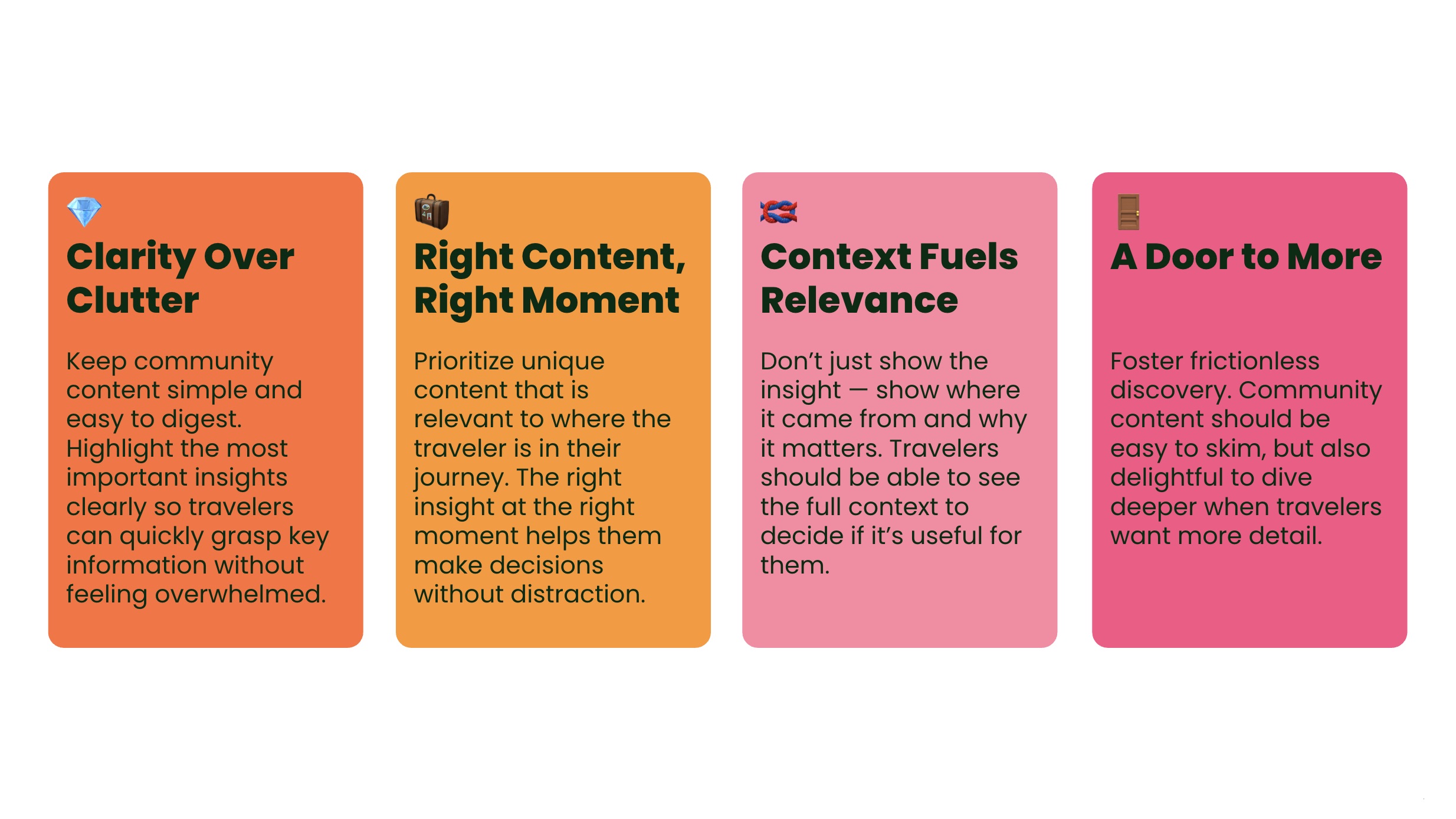
I worked with the Designer and PM to translate the findings into four principles that would guide the prioritisation and iteration of sprinkles going forward, as well as shape the Community team's milestone planning.
This also gave the team the confidence to push the initiative forward. The research answered the strategic question. The team had what it needed to make the case to leadership.
The outcome
The research was presented to the VP of Traveller Products, who oversaw the Experiences, Hotels, and Restaurants product teams, and he came on board.
This mattered because introducing sprinkles on pages owned by other verticals required collaboration that the Community team could not mandate on its own.
A community-content sprinkle on a hotel detail page is not just a Community team decision. It sits on a page owned by the Hotels team, drawing on content that touches Experiences and Restaurants too. Without cross-vertical buy-in, the initiative would have stalled.
The VP's support meant the Community team could pursue opportunities to work with Experiences, Hotels, and Restaurants as they refined their milestone roadmaps. It opened a new phase of cross-vertical collaboration made possible by the research.
Reflection
When the strategic question is abstract, the instinct is often to keep the research open-ended and exploratory. But openness without structure is how you end up with conversations that produce nothing usable.
Without that grounding, we would have learned that travellers value community content (which we already knew) and missed the sharper question of how, where, and in what form that content actually helps them. The method did not constrain the research. It made the research possible.